張寧 Niina Ning Zhang
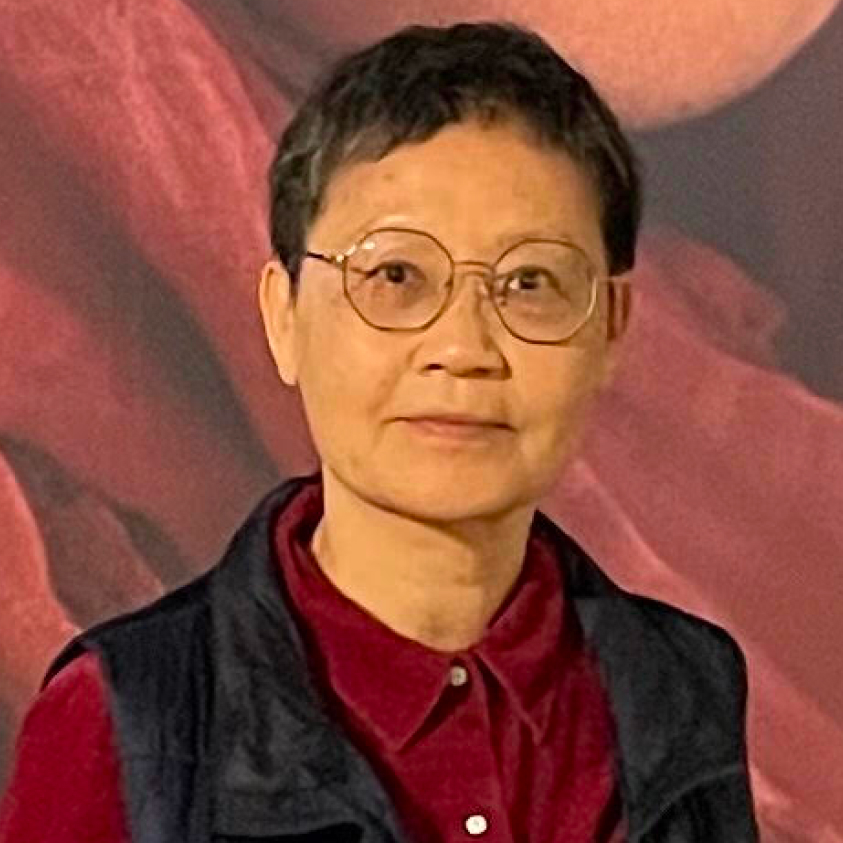
國立中正大學語言學研究所講座教授
學歷
- 加拿大多倫多大學語言學博士(1997)
- 上海外國語大學語言學碩士(1990)
經歷
- 國立中正大學教授(2011/8~迄今)
- 國立中正大學助理教授(2003/8~2011/7)
- 德國柏林ZAS語言學研究中心研究員(1997/10~2003/7)
個人勵志銘
科學永遠在被挑戰中向前邁進。
A Syntactician Explains What People Don’t Know They Know
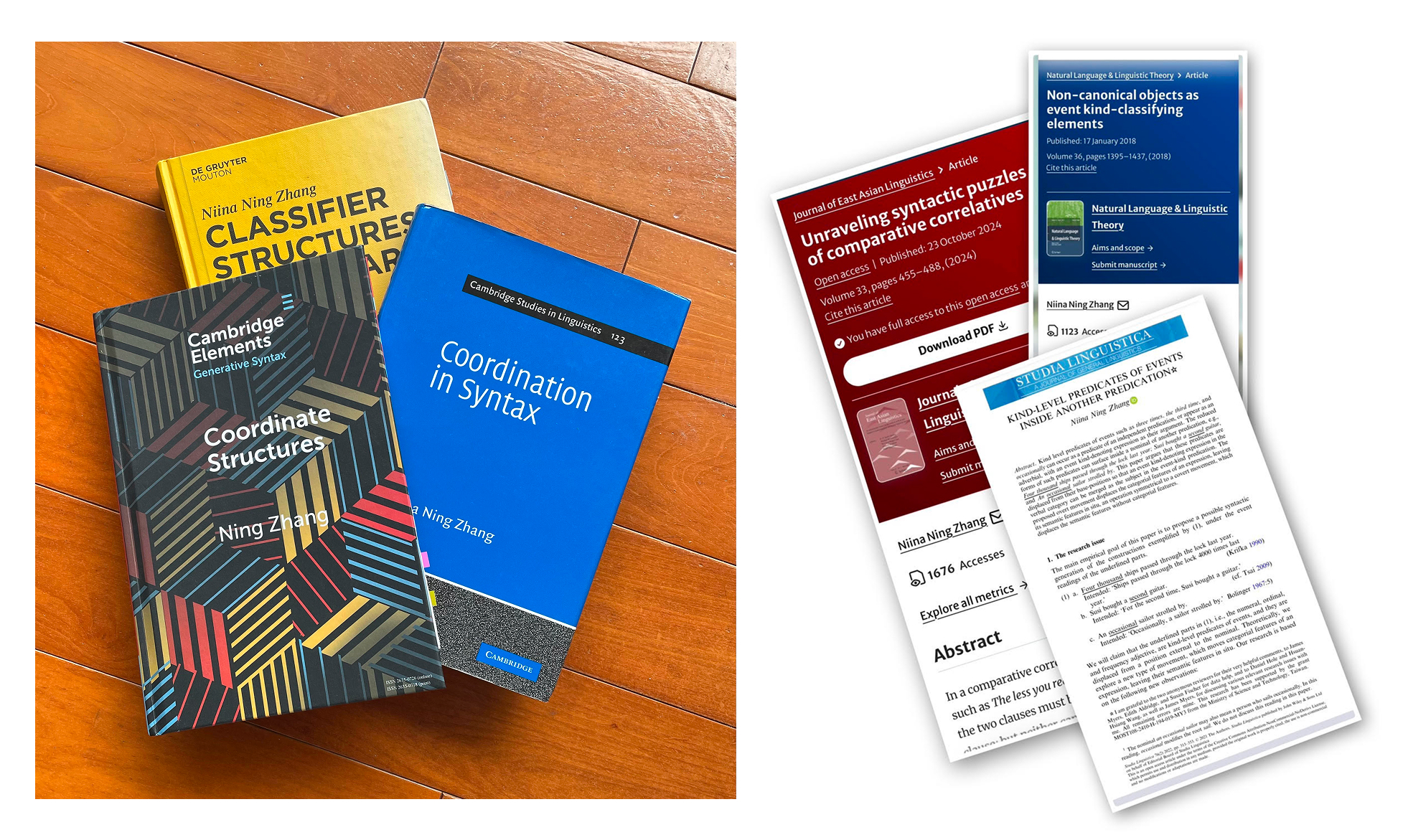
I explore the underlying natural laws of human language by testing hypotheses about sentence structure. One of my achievements in the past six years of research on my National Science and Technology Council projects is Coordinate Structures (2023, Cambridge University Press), wherein I claim that the structures of coordination (e.g., “Snow is white and grass is green” ) and modification (e.g., “the green grass” ) can be unified into a single structure type. I find that the special abstract elements essential to both structures, namely conjunctions like English “and” in coordination and the Mandarin Chinese modification marker de (的, 地, 得), share many structural properties. Cross-linguistic differences are also explainable in terms of these abstract elements: unlike English, Chinese has many different conjunctions (e.g., 和, 跟, 以及, 並且, 又 ), while unlike Chinese, English does not have any modification markers at all. Other recent research achievements include my explanation of the syntax of comparative correlative constructions (e.g., 文章越短越難寫 ), which are unusual in that they depend on pairings like yue-yue in Chinese and “the more…the more” in English, and my demonstration that non-canonical objects in Chinese (e.g., 我們來吃這家餐廳, where we won’t literally eat the restaurant!) actually classify event types, as opposed to individual event tokens, which occur when the verb is used as a special type of intransitive verb (e.g., when 吃 just refers to the act of eating). This last research study has now led me to consider how syntax represents event types, in addition to the much better studied entity types, thus shedding new light on the structure of mental representations in the human cognitive system.
得獎感言
I feel very lucky for receiving support from the NSTC for my research every year for so many years. I have also received help from my colleagues at National Chung Cheng University and fellow scholars across Taiwan, my research assistants, and my family. I am grateful to them all. This award is the result of the collective effort of both academic and non-academic people around me. From a research perspective, what I have learned from my working experience is that one must be brave to face challenges. Very often, paper submissions get rejected or even misunderstood for various reasons. But as scholars, we trust science. We believe that challenges can strengthen us.
 Copyright 2026 © National Science and Technology Council 國科會
版權所有
Copyright 2026 © National Science and Technology Council 國科會
版權所有